
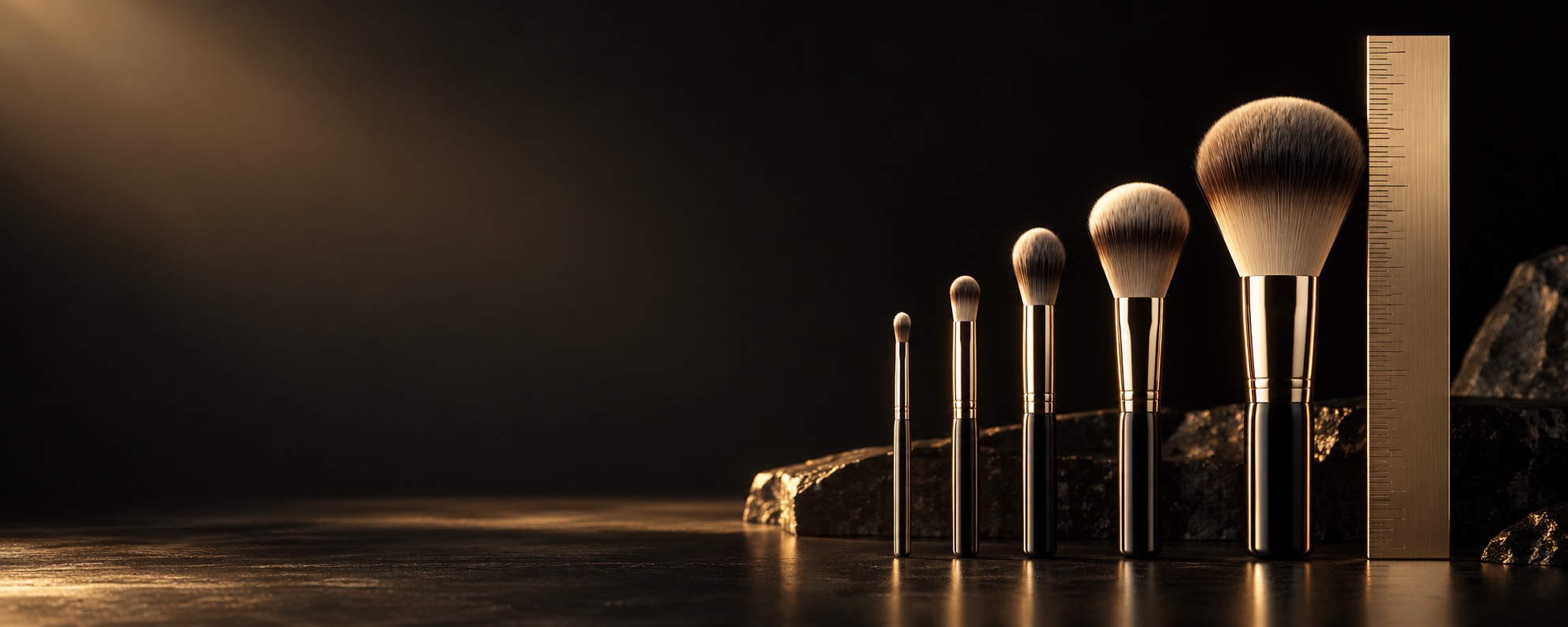
A reference photo is a useful starting point for custom makeup brushes. It is not a complete product specification. Two brushes can look similar while using different fibres, head dimensions, ferrules or handles, and those differences matter when a customer applies a formula.
Before requesting a sample, decide what each brush should do, which components need to change and how the finished product will be packed. This guide explains those decisions using the options shown on HEXUE's custom makeup brushes page.
Start with the application, not the colour
Write down the intended job of every brush in your collection. A powder brush, a cream foundation brush and an eyeliner brush should not share the same acceptance checklist simply because they have matching handles.
For each model, identify the product it will apply, the desired coverage and the area of the face. Then specify a head shape and size to discuss during sampling. For a set, give each brush a clear role rather than adding similar shapes to increase the piece count.
An eye-focused assortment may need blending, placement and liner formats. A complexion assortment may prioritise foundation, powder, blush and contour. These are planning examples, not fixed set configurations. Explore HEXUE's brush collections to find references that fit your range.
Explore a starting reference for your collection
Use a product reference to make your enquiry specific. These HEXUE collections offer different starting points for discussing set contents, format and branding:
| Collection | What to discuss for your project |
|---|---|
| Taoyao 7-Piece Brush Set | Review the selected brush roles, coordinated colour and pouch direction for your collection. |
| Double-Ended Aluminum Tube Brush Set | Discuss the double-ended format, preferred combination and branding surfaces. |
| 10-Piece Short-Handle Travel Brush Set | Review the compact format, set contents and travel packaging. |
| 15-Piece HEXUE Makeup Brush Kit | Compare a larger assortment with the applications your customers need. |
Include the product link in your enquiry and identify what you would like to change. A displayed reference does not mean every modification, colour or order quantity is available without confirmation.
Choose which parts of the brush need to change
HEXUE's customization page separates the brush into the head, ferrule, handle, branding and packaging. A useful buying brief keeps these decisions together.
| Part | What to specify | What to confirm on a sample |
|---|---|---|
| Brush head | Fibre or hair type, profile, exposed length, colour and desired density | Shape, feel, pickup, release and behaviour with the intended formula |
| Ferrule | Material, dimensions, colour, surface finish and any branding | Fit, edges, appearance and connection to the handle |
| Handle | Material, length, profile, colour and finish | Grip, balance, surface consistency and compatibility with the chosen logo process |
| Logo | Artwork, application surface, size, position and process | Legibility, alignment, colour and adhesion under the agreed checks |
| Packaging | Set contents, package type, insert and printed information | Fit, brush protection, correct contents and the agreed packed presentation |
Do not use a material name as a substitute for a performance brief. If you want synthetic fibres, still explain the softness, flexibility and makeup finish you expect. If you require a vegan specification, state that requirement explicitly and confirm its scope with the supplier.
For colour matching, send a PANTONE reference where available. Identify the reference for each component instead of writing only “pink brush set.” The bristles, handle, ferrule and pouch may each require a separate colour decision.
Decide between branding an existing design and developing a new shape
An existing brush reference can provide a starting point when you mainly need a logo or a different decorative finish. Ask which features will remain unchanged and which changes require a new sample.
A new head profile, handle structure or moulded component needs more than an attractive image. HEXUE's page explains that new shapes require a precise drawing before modelling and sample development. Agree the important dimensions and the drawing version before moving ahead.
This distinction also makes quotations easier to compare. A price for a familiar brush with handle printing is not directly comparable with a price that includes new tooling, a different fibre specification and custom packaging. See the OEM and ODM solution for the wider project process.
Match the logo process to the actual surface
HEXUE lists options including screen printing, hot stamping, pad printing and laser engraving. The suitable method depends on the component material, its finish and the artwork.
Send the original artwork, not just a screenshot of a logo on another product. Mark the desired position on the handle or ferrule, add the print size and identify any required colour or metallic effect. Ask the supplier to review fine lines and small lettering before the sample is made.
Review the logo on the actual chosen surface. A digital mock-up can establish position, but it does not show how the finish looks or wears on a physical brush. If you change the handle coating or ferrule finish after approval, ask whether the logo process needs another check.
Confirm MOQ in sets, then clarify the configuration
HEXUE's customization and OEM pages state the following starting quantities for makeup brush sets:
| Handle material | Stated starting MOQ |
|---|---|
| Wood | 1,000 sets |
| Plastic | 5,000 sets |
The final quantity basis depends on the selected styles, set configuration and packaging. Confirm it in the project quotation. These figures should not be read as a universal minimum for every single brush or accessory.
Ask whether the agreed MOQ applies to each set, colour or configuration. Also ask whether a pouch, printed box or insert has a separate minimum. Do not assume that several colours can be combined to meet one minimum unless the supplier confirms it.
For example, an order of 1,000 five-brush sets contains 5,000 individual brushes. If you want the sets split between two colours, specify the intended split and request confirmation. This is a quantity illustration, not an offer to produce that split.
Choose packaging while you specify the brushes
HEXUE shows options such as OPP or zip bags, pouches, paper boxes, PVC boxes, gift boxes, brush cases and custom inserts. Choose the format around the sales channel and the actual brush dimensions.
A reusable pouch can form part of a travel collection. A printed box can carry brush names and usage information. An insert can help present a set, but its layout must match the approved brush shapes. These are choices to review, not a claim that one format suits every project.
Before approving the package, check the longest brush, the largest head and any components that could rub together. Confirm the final brush count and the order in which the set is packed. Request packed dimensions and carton information when comparing freight options.
If your first enquiry specifies only the brushes, adding packaging later can change both the quote and the sample plan. Include at least a packaging direction in the initial brief.
Approve a physical sample against a written checklist
HEXUE's sample page asks buyers to provide a reference, dimensions, branding direction, expected quantity and target market. Sample cost, freight and timing are quoted by project rather than presented as one fixed promise.
Use the sample to review the brush with the intended cosmetic formula. Record what you approved and what still needs adjustment. A useful checklist covers application performance, head shape, handle balance, surface finish, logo position and packaging fit.
Agree how appearance, shedding, connection strength, colour transfer and logo adhesion will be checked for your order. The quality control page provides a starting point for that discussion. A list of test names alone does not define the method or acceptance criteria, so include those details in the agreed plan.
Keep the approved sample and the final specification linked by a clear version or model reference. If a material, dimension or finish changes, confirm what needs to be resampled before production continues.
What to send HEXUE for a custom brush quotation
You do not need every technical answer before making contact. You do need a clear description of the project. Copy this outline into your enquiry:
- Brand, target market and sales channel.
- Single brush or set, with the role of each brush.
- Reference photos, drawings or an available physical sample.
- Preferred head, ferrule and handle materials and dimensions.
- Component colours and PANTONE references, if available.
- Logo artwork, placement, size and preferred effect.
- Packaging direction and any insert or label requirements.
- Quantity per style, set and colour, plus the intended launch date.
Compare the featured brush catalog if you are still deciding on a starting model.
Ready to define your collection? Review HEXUE's customization options or send a project enquiry with your reference, quantity and packaging direction. The next step is a confirmed specification and sample plan for your chosen configuration.
Frequently asked questions
Can I put my logo on an existing brush design?
An existing reference can be reviewed for branding changes. HEXUE lists several handle and ferrule decoration methods. Confirm the chosen surface, artwork and quantity before a sample or production plan is agreed.
Do all custom makeup brushes need new tooling?
No. A selected existing shape may provide a starting point. A new shape or moulded part can require drawings and tooling work, which should be confirmed and quoted separately for the project.
Is MOQ counted in brushes or sets?
HEXUE's published figures above are for brush sets. Ask for the unit basis of your specific quotation and confirm any separate requirements for colours and packaging.
How long will a custom sample take?
HEXUE confirms sample timing, cost and freight in the project quotation. The requirements differ between matching an existing design and developing a new one.