
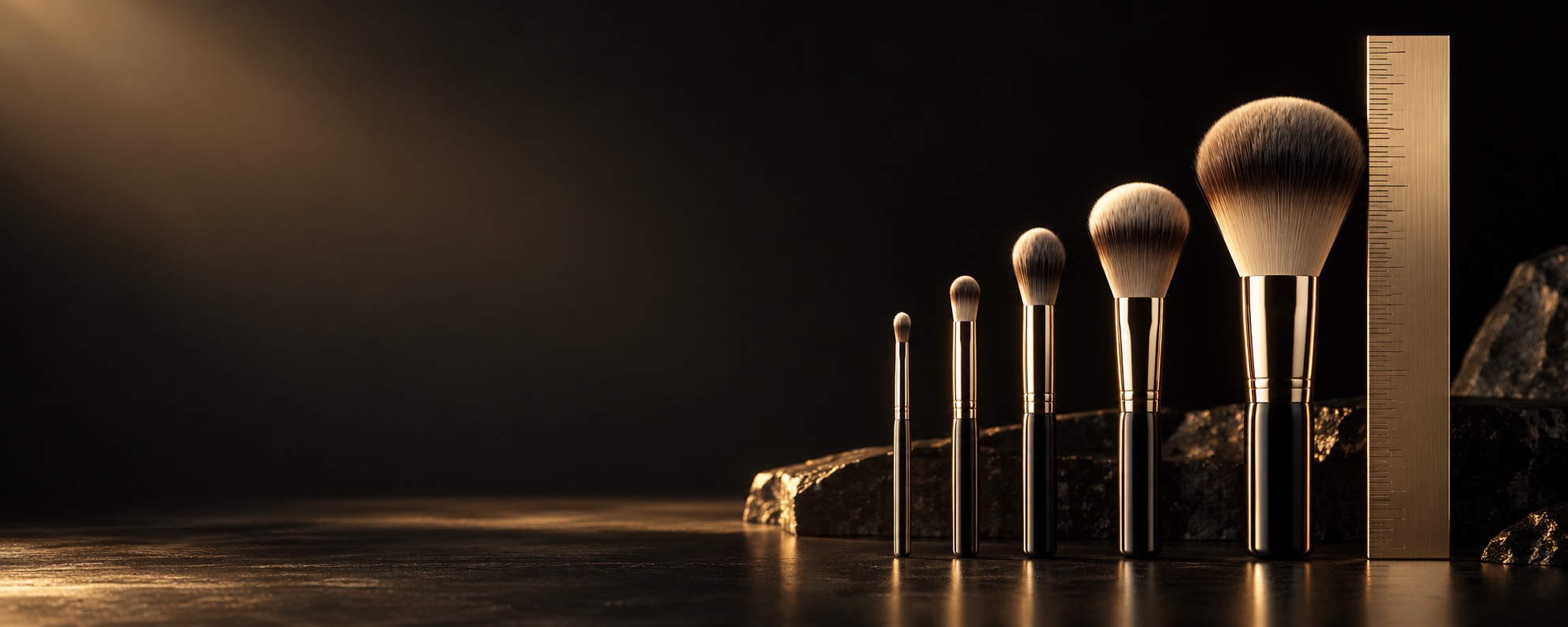
Bristles are the part of the decision that buyers notice first and cost out last. Before comparing prices, it helps to separate the three things fibre actually controls: how much product the head picks up, how evenly it gives it back, and how the tip feels on skin.
Animal hair: what the grades mean
Goat hair is the most common animal fibre and can cover high, mid and entry-level programmes, which is why the grade matters more than the species. The grades we work to are fine light tip, medium light tip, white tip, yellow tip, No.2, No.10, double-even and single-even. Two heads can both be described as “goat hair” and behave completely differently.
Other options are grey squirrel, squirrel, horse, weasel (kolinsky), raccoon, badger, ferret-badger and boar bristle. They are not interchangeable: kolinsky and squirrel behave very differently from boar, and a brush specified for one will not read the same in the other.
Synthetic fibre: two shapes, two jobs
Synthetic is where most private label volume sits, and it comes in two filament forms that are not substitutes for each other.
- Straight filament holds together well, keeps a defined edge and suits foundation and eye brushes.
- Wavy filament is crimped, so it spreads rather than clusters. That makes it the better choice for large powder and blush brushes, where you want diffusion rather than placement.
Both are available in single-colour, two-colour, three-colour or mixed heads. A two-colour head with a light tip is a common way to signal softness on the shelf, but the visual effect and the actual feel are separate decisions and should be specified separately.
Matching fibre to the product
Start from the formula, not from the fibre name. A liquid foundation needs a head that releases product rather than holding it, which points to a dense straight head. A pressed powder needs spread and a light touch, which points to a fanned or domed head in wavy filament. A cream blush sits between the two.
What to ask before approving
Ask for the fibre type in the specification, not just the description, and judge the sample in the hand: pick up product, apply it, wash the brush and apply again. A head that changes shape after one wash will not survive a retail customer’s first month. Density, shedding and the ferrule-to-handle joint are all testable — see quality control for the standards we hold.
If the range mixes animal and synthetic fibre, say so at specification stage. It affects sampling, tooling and how the collection is described on the box.